
Read Franklin County Tax Record Fields
Franklin County keeps assessment and collection under one roof. The Franklin County Tax Assessor/Collector locates, classifies, and appraises taxable property every year. The office also maintains ownership maps, updates the roll, presents it before the July Board of Supervisors meeting, and receives ad valorem taxes on those same parcels.
| Field | What It Shows | Where |
|---|---|---|
| True or appraised value | Estimate before the statutory class ratio | Assessment roll |
| Assessed value | Taxable fraction produced by the class ratio | Assessment roll |
| Exemptions | Homestead treatment applied to the account | Assessor record |
| Tax bill and status | Amount billed and payment or delinquency information | Collector system |
| District context | Local taxing jurisdiction tied to the parcel | Tax record and district lookup |
Mississippi values property by class. The Department of Revenue appraisal guidance sets a 10 percent ratio for Class I owner-occupied residential real estate. That class covers homes their owners live in. Class II, covering other real property, carries a 15 percent ratio. Assessed value is not a sale price. The final tax bill still turns on millage rates and exemptions.
One Franklin County Property Tax Office, Two Jobs
Assessor Julie Buckels can be reached at P.O. Box 456, Meadville, MS 39653, or by telephone at 601-384-2359. Assessment questions cover classification, true value, assessed value, ownership maps, roll entries, and homestead. Collection questions cover the bill, payment, delinquency, and sale.
The split matters when reading records. A parcel card explains the value base but may not prove the current bill was paid. A payment screen shows a balance yet says nothing about the appraisal behind it. Keep both records in any appeal or due-diligence file.
Search Franklin County Property Tax Assessment Records
The Franklin Tax portal offers owner, address, parcel-number, advanced, tax-bill, and map search modes. Its landing page currently shows a "Last Updated 04/Sep/2026" notice. Maintenance blocks a complete parcel and bill result for now, but you can still open the official portal directly.
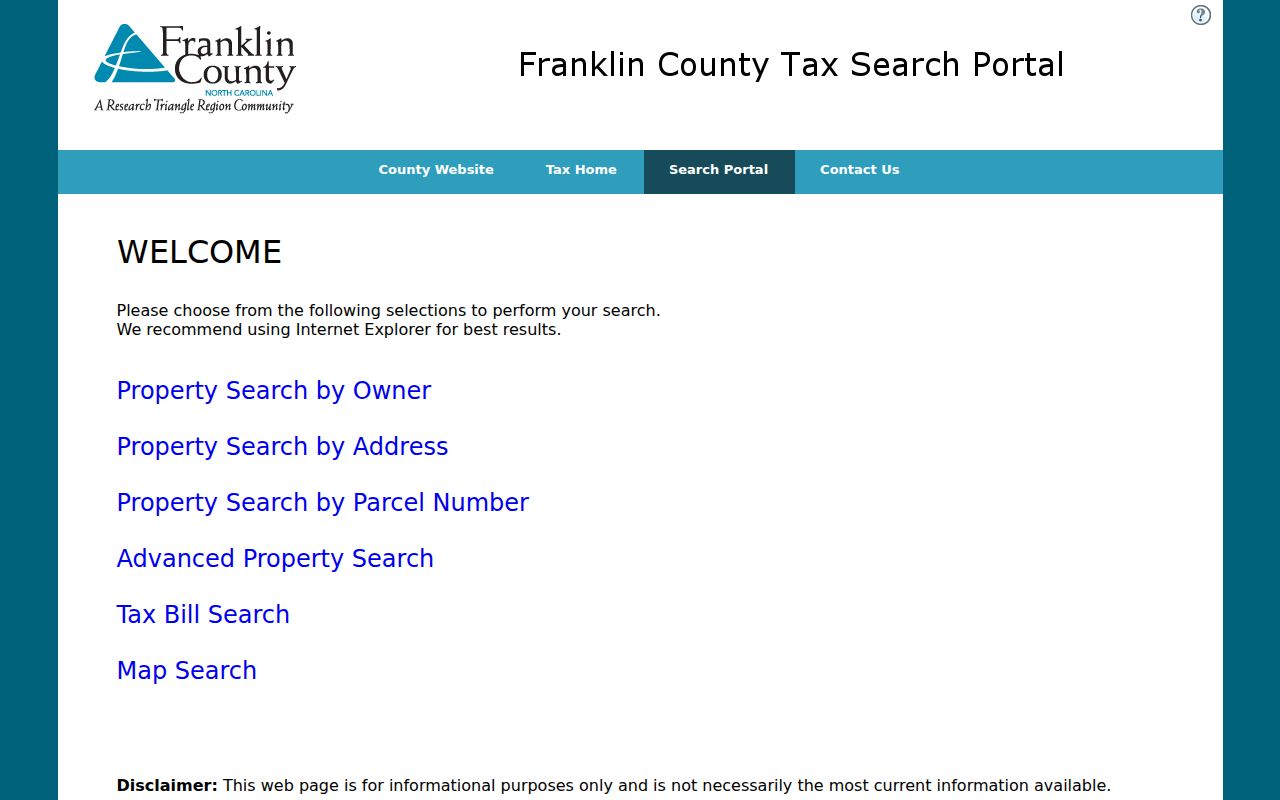
The image shows the search routes and the outage. It does not display a sample tax bill's payment fields, and the county has not documented its online historical coverage.
Calculate Franklin County Property Tax Assessment Values
- True value
- The appraisal base before applying a property-class ratio.
- Assessed value
- The statutory percentage of true value used in the tax calculation.
- Millage
- The levy applied to taxable assessed value.
- Homestead exemption
- Relief for an eligible owner-occupied home.
- Tax lien
- The public claim arising from unpaid property tax.
Read the class, value year, exemptions, and taxing district together, because a change in any one can move the bill without a sale ever occurring. One piece alone can mislead. For a deeper comparison of assessed and sale values, see the Franklin County property value guide.
Apply for Franklin County Property Tax Homestead Relief
Franklin County accepts homestead applications from January 1 through April 1. The program offers a regular homestead credit. Special treatment goes to an owner who reached age 65 before January 1. An owner who is 100 percent disabled also qualifies. The Mississippi DOR homestead page lays out statewide eligibility and document guidance.
Annual reapplication is generally unnecessary once approved. Death, marriage, divorce, or a partial sale changes that. Confirm the documents with the assessor. Do not assume last year's exemption still fits your circumstances.
Look Up a Franklin County Tax Bill
Use the parcel ID when possible to avoid address-format ambiguity. The county portal links to a tax-bill and payment gateway, but the gateway currently returns an error. The county publishes no online payment-fee schedule.
- Find the parcel by address, owner, or parcel ID in the Franklin Tax portal.
- Open Tax Bill Search and verify the bill year, amount, and status when the gateway is working.
- Compare exemptions and assessed value with the assessment record.
- For delinquency, ask the collector about sale and redemption status rather than relying on a stale screen.
- Bill year
- The annual tax cycle to which the charge belongs.
- Payment status
- The collector's posted paid, due, or delinquent state.
- Redemption
- The statutory opportunity to recover sold land before title becomes absolute.
- Mobile home sale
- A separate delinquency cycle that the county says has no redemption.
February Bills and April Land Sales
Franklin County land taxes come due each year by February 1. Delinquent real estate and special-assessment property is sold on the first Monday in April. A two-year land-redemption period follows that sale. Mobile-home delinquency sales happen in October. Mississippi law provides no redemption from a mobile-home sale, according to the county page.
These dates describe the ordinary cycle only. A particular parcel can differ because of payment, later redemption, litigation, or correction. Confirm its status directly.
A 2025 Franklin Redemption Record
An August 2025 land-redemption notice covered property sold on August 28, 2023. It set a July 25, 2025 nonredemption point. It also set an August 28, 2025 deadline under Miss. Code §27-43-3. The notice listed parcel numbers, PPINs, legal descriptions, subdivisions, and Bude or Meadville addresses.
Read the source notice shown below.
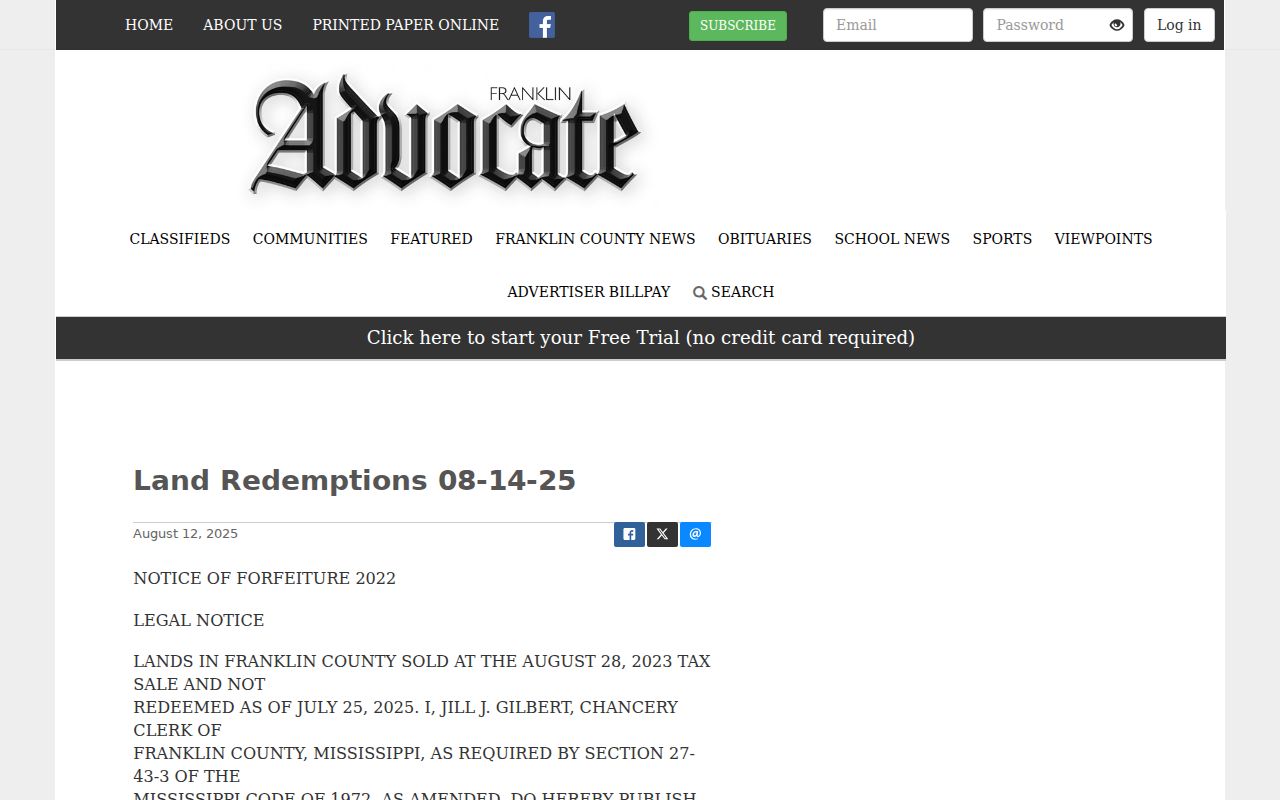
The notice is a rich search lead. Current status still rests with the collector, while the resulting tax deed or redemption filing belongs with the Chancery Clerk.
Contest a Franklin County Assessment
Start locally with the assessor. Review the parcel class, true value, and assessed value in that office. Check the exemptions too. Look at the land and improvement details, and bring comparable evidence. The roll goes before the July Board of Supervisors meeting. Ask for the current local objection calendar instead of guessing a filing date.
State-level help exists too. The Mississippi DOR appeal guidance sets a 20-day deadline for an assessment appeal to the Board of Tax Appeals. It allows 60 days for certain other agency actions. That route supplements, not replaces, the local roll review.
Appeal window. Ask the Franklin County Tax Assessor/Collector for the current local deadline immediately. A state assessment appeal has a short 20-day window under the DOR guidance once the appealable action occurs.
Reconcile Franklin County Property Tax Records by Year
Sort out four different dates before comparing anything. The assessment year, bill year, payment date, and portal update date each tell their own story. Franklin County's assessor refreshes the tax roll once a year. It is presented before the July Board of Supervisors meeting. A payment posted later may belong to a different snapshot. So may a transfer of ownership. Either one may not match the figure on your screen. Save the parcel number and tax district beside every number you copy. A later comparison will still point to the same account.
When a bill and a parcel card disagree, take the mismatch to the right desk. The Franklin County Tax Assessor/Collector is one combined office. Its records are not interchangeable. Assessment covers classification, true value, assessed value, land and improvement splits, and exemptions. Collection covers payment status, delinquency, tax sale, and redemption. Ask which side owns the correction. Do not assume either record is wrong.
Public notices work well as a trail for delinquent land. The 2025 Franklin County redemption notice lists PPINs. It also gives parcel formats, legal descriptions, named subdivisions, and city addresses. Match those clues against the current property tax record. Check the Chincery Court filings too. Then weigh what you find. A deadline that passed does not prove the land stayed unredeemed. A sale that once occurred does not prove that title became absolute.
Is the online system down for maintenance? Call 601-384-2359 or send a narrow public-record request instead. Name the parcel, the tax year, the fields you need, and ask for current fee information. A focused request like that gets better results than a vague plea for a full property history.