
Recognize Franklin County Deed Types
The Franklin County Chancery Clerk keeps the recorded-land archive. Deeds name the parties and describe the interest conveyed. A deed of trust or a lien, by contrast, records an encumbrance rather than an ordinary transfer of ownership.
| Deed Type | What It Does | Common Use |
|---|---|---|
| Warranty deed | Conveys the stated interest with title covenants | Ordinary sale |
| Quitclaim deed | Conveys whatever interest the grantor has | Family or title cleanup |
| Special warranty deed | Uses narrower covenants | Limited-warranty transfer |
| Executor or administrator deed | Conveys through an estate representative | Death-transfer trail |
| Trustee or tax deed | Documents a trustee or tax-sale conveyance | Foreclosure or delinquent-tax chain |
Look past the title and read the granting language. Recording places an instrument in the public record, but it does not settle every competing or unrecorded interest.
Franklin County Deed Records in the Chancery Index
Chancery Clerk Jill Jordan Gilbert maintains the deed records at 36 Main Street in Meadville, with mail to P.O. Box 297 and telephone at 601-384-2330. The clerk's holdings run deep. The Franklin clerk inventory catalogs General Index-Deeds, deeds of trust, substitutions, sectional indexes, maps and plats, lis pendens, construction liens, federal tax liens, civil judgments, Chancery dockets, supervisors' minutes, and wills. Review the inventory through the official-source link.
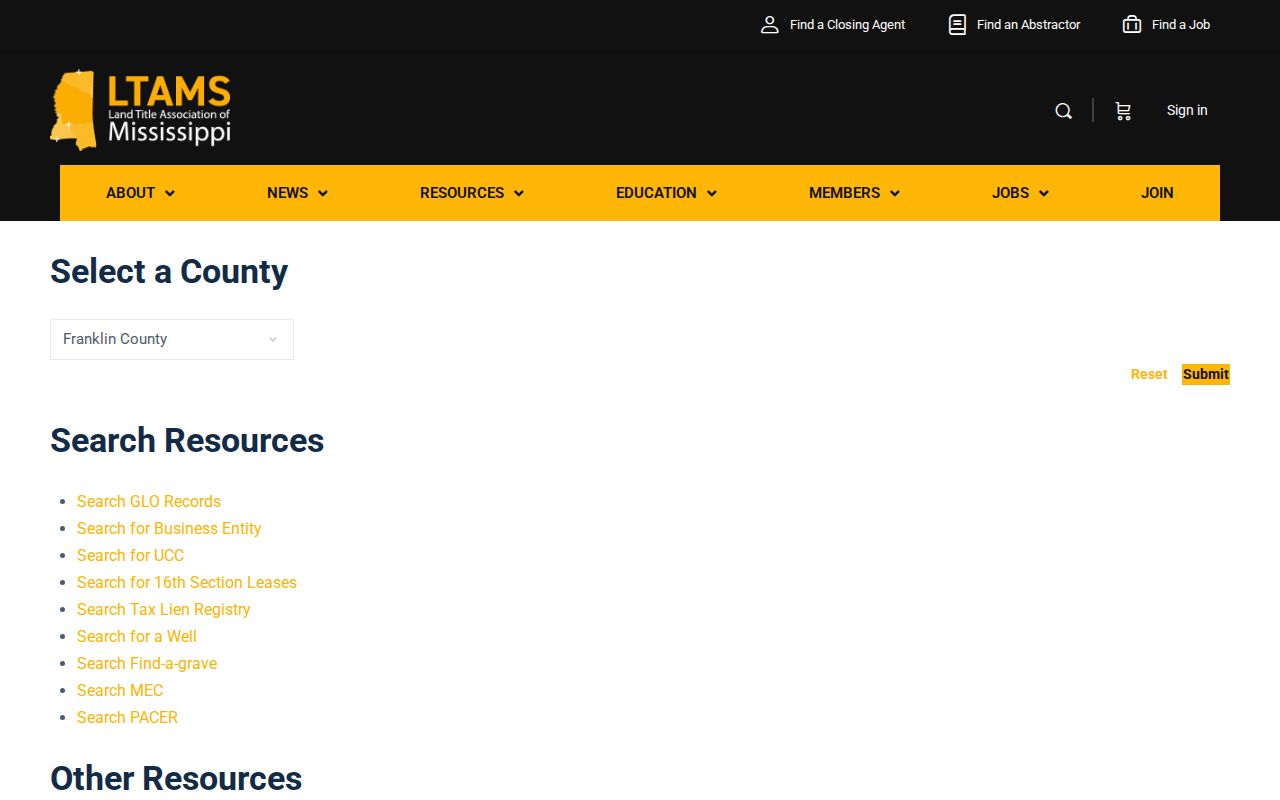
The association page publishes no online land-search link. Treat it as a catalog of holdings rather than a free deed-image portal.
Franklin County Deed Records, Releases, and Liens
A deed of trust names the borrower, lender, trustee, and the secured land. It does not convey ownership to the lender. When the trustee changes, search the substitution. When the obligation is satisfied, search the release. Construction liens, federal tax liens, judgments, and lis pendens can cloud the land trail without ever appearing as deeds. Use exact names and legal descriptions in every category. Some filings point straight into litigation, and the DCS Chancery portal describes its case coverage as 2000 to present, with a $30 monthly subscription and scanned court pages at $0.50 each. Those case terms are not a confirmed deed-copy schedule, so confirm pricing with the clerk before paying for land records.
Read Franklin County Deed Records With Plats
Subdivision deeds often cite a lot, block, and addition. A recorded plat sits behind that description. Rural instruments lean on metes and bounds or Section, Township, and Range instead. Roxie's original town survey includes Block 13. A 2026 McCall Creek proceeding cites Plat Book 1, page 30. The Mill Street and Magee Street notice shows how current governmental action can rest on an old plat, so use it as a lead and obtain the filed plat and instrument.
Walk the Franklin County Deed Records Chain
Begin with the newest reliable owner. Work backward one transfer at a time. Search that owner as grantee, read the named grantor, then search that grantor as an earlier grantee. Match the land description at every step, because one party can convey several tracts.
- Find the current owner's acquisition deed with the owner as grantee.
- Copy the grantor, date, deed type, and recording locator.
- Search the grantor as a grantee and verify the same legal description.
- Repeat until online access ends, then continue in deed books or microfilm.
- Grantor
- The party conveying the stated interest.
- Grantee
- The party receiving it.
- Chain of title
- The linked sequence of transfers for the same land.
- Book/Page vs Instrument #
- The clerk's locator for a recording.
Estate transfers can break the simple seller-to-buyer pattern. Check wills, probate dockets, executor deeds, and the later deed that returned the land to an ordinary transfer chain.
Know the Franklin County Deed Records Online Gap
The Franklin DCS page advertises instrument indexing and land-record subscription access, but the land-result screen sits behind a subscription gate. The earliest online deed year is not stated. Open the vendor page and read the current terms.
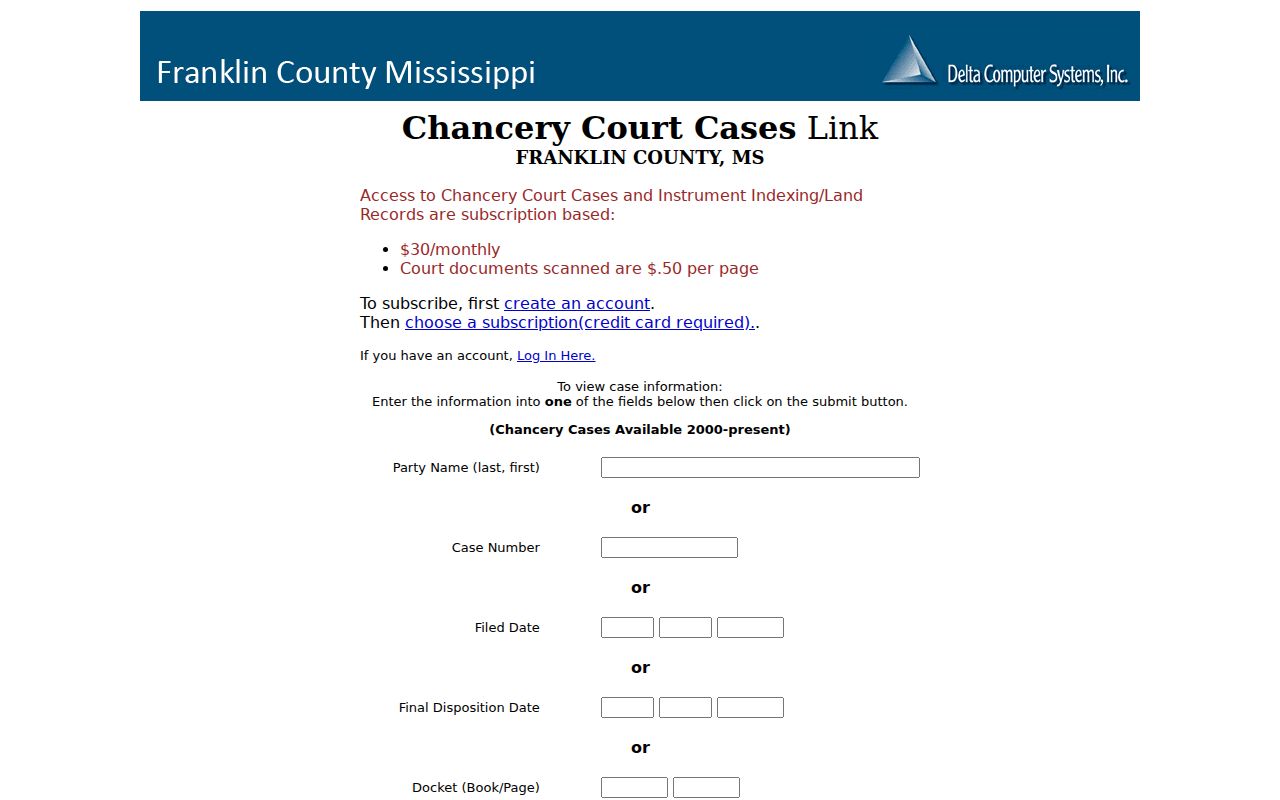
The subscription notice makes the clerk counter the practical route. A narrow, direct request also works. Do not assume the portal's case coverage or page charge applies to land records unless the clerk confirms it.
Continue Franklin Deeds in Historic Holdings
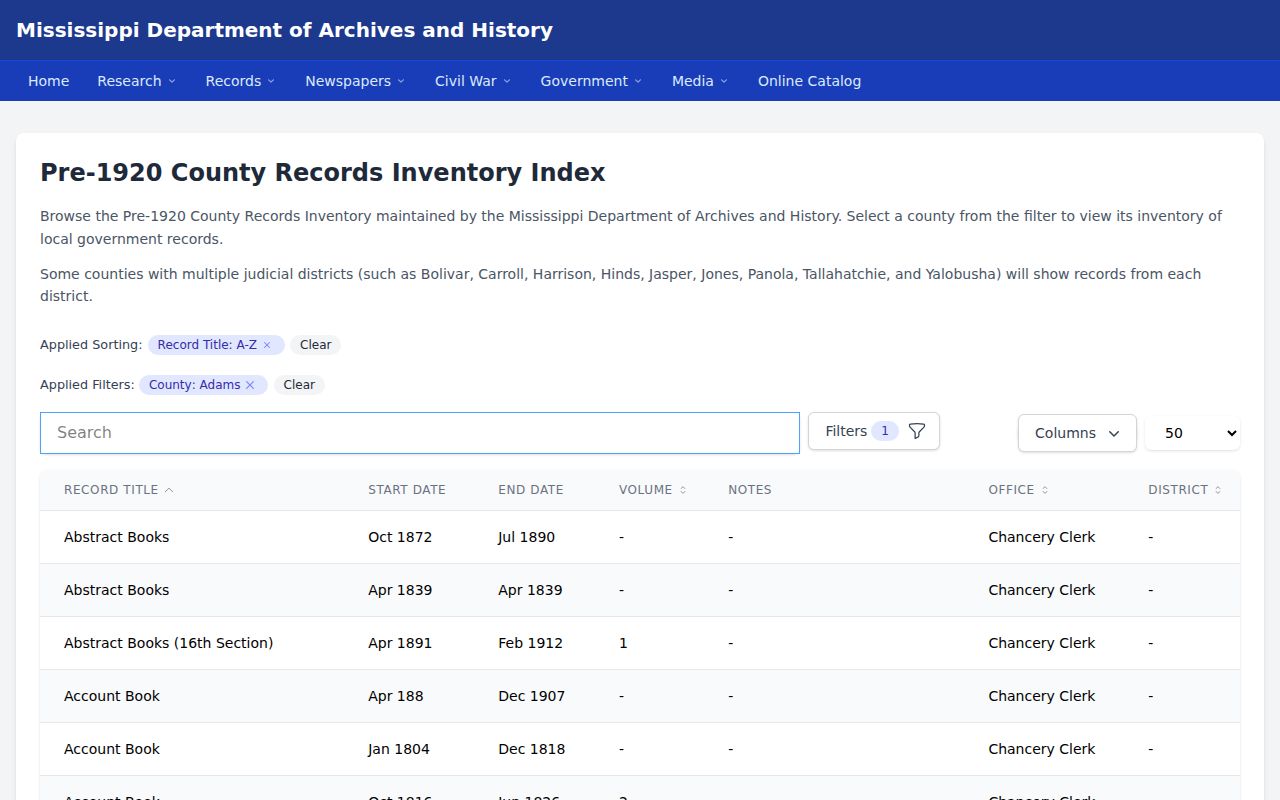
When online access ends, the paper trail continues. Deed books, county microfilm, and the MDAH Franklin finding aid carry the older Franklin instruments. The pre-1920 inventory searches record title, date, volume, notes, and office. It doubles as a finding tool. MDAH's Franklin tax-roll series spans 1818 through 1887. It can corroborate historical clues, though a tax roll is not a deed. Wait, check that.
Browse the archive catalog before requesting volumes.
The county publishes no official account of a courthouse fire. Reconstruct gaps through deed books, plats, probate, tax rolls, and newspapers rather than an assumed loss story.
Turn Public Notices Into Record Leads
Franklin Advocate notices can expose parcel numbers, PPINs, legal descriptions, and old book and page references. Survey dates, additions, and parties can appear too. Clues like these are only a start. A 2025 Roxie notice used an executrix deed. It also cited the original Town of Roxie survey for a cemetery conveyance. Carry every lead further. Confirm it in the official deed, plat, will, lien, and current tax-roll records.
Note: A newspaper description identifies what to request, but the clerk-held instrument remains the filed record.
Request a Franklin County Deed Copy
The Chancery Clerk needs a few details to pull a deed. Give a party name, an approximate date, and the legal description. A parcel or PPIN number helps too. Do you have a book and page or an instrument number? Include that as well. It points straight to the record. Ask about the copy format too. It may come electronically, as a plain copy, or as a certified copy. Local pricing varies, so request current fees before sending payment.
Several routes work for a Franklin County deed request. Try the vendor index if it is available, or visit the courthouse counter in person. The clerk also takes calls at 601-384-2330 and mail at P.O. Box 297. Some records seem hard to reach. A focused request under the Mississippi Public Records Act is another option for those.
Recorded, not guaranteed. Franklin County deed records show filed instruments, not a legal opinion that title is clear. Unrecorded interests and competing claims require professional title examination.
Resolve Franklin County Deed Records That Do Not Link Cleanly
A grantor-grantee chain rarely breaks at random. The next transfer may have passed through an estate, a trustee, a spouse, a business entity, or a name change. Work both sides of every known instrument. Write down the grantor, grantee, deed type, date, legal description, and the book-page or instrument reference for each one. When tracing backward, treat the prior grantee as your next grantor and repeat the loop until the Franklin County chain closes or stalls at a document you can pull.
Probate and Chancery records often explain a transfer that looks nothing like a sale. The clerk's indexed groups cover wills, Chancery dockets, and land instruments together, so search all of them. A lis pendens or a judgment entry can point straight to a case file worth reading. Be careful, though. A case outcome is not a deed unless a conveyance was actually recorded.
Older Franklin County deed records live in the physical General Index, the deed books, the Map/Plat Book, and the MDAH finding aids, so bring your names and the land description with you. Historical tax rolls can show who was assessed on the parcel in a given year. They corroborate a trail. They never substitute for a missing conveyance. The official sources publish no start year for online deeds, so let the index response itself tell you where the books take over.
Know the difference between a plain copy and a certified copy, and between a record search and a title examination. The clerk supplies filed material and certification options. A title professional is the one who judges whether the instruments, exceptions, releases, probate steps, and other interests add up to a legally sufficient chain.